
If you haven't subscribed to the American Heritage Museum YouTube Channel yet, you've been missing out on some great content, like this week's full tank tour of the British Matilda II tank located in the North Africa Gallery with Sarah - check it out and subscribe!
"The Queen of the Desert" - Matilda II Full Tour
www.youtube.com
The Matilda II is one of the most iconic British tanks of the Second World War, and was unmatched in the early years of the North African campaign. Well arme...
Meet the P-40B Tomahawk!![]()
![]() #AmericanHeritageMuseum #VisitMA #militaryhistory #historymuseum #WWII
#AmericanHeritageMuseum #VisitMA #militaryhistory #historymuseum #WWII
Since the last upload of this video was cut short, we'll try it again! ![]()
![]() Meet the German "Flak 88"!
Meet the German "Flak 88"!![]()
![]() #AmericanHeritageMuseum #VisitMA #MilitaryHistory #HistoryMuseum #WWII
#AmericanHeritageMuseum #VisitMA #MilitaryHistory #HistoryMuseum #WWII
This Friday, March 6th starting at 12:00pm, join us at the AHM for an extraordinary presentation on tank technologies with Master Gunner and tank platoon Sergeant Gregg Pomerleau. No reservations needed.
Let's Operate an MG-42 in First-Person!![]()
![]() #AmericanHeritageMuseum #VisitMA #militaryhistory #historymuseum #WWII
#AmericanHeritageMuseum #VisitMA #militaryhistory #historymuseum #WWII
Gulf War
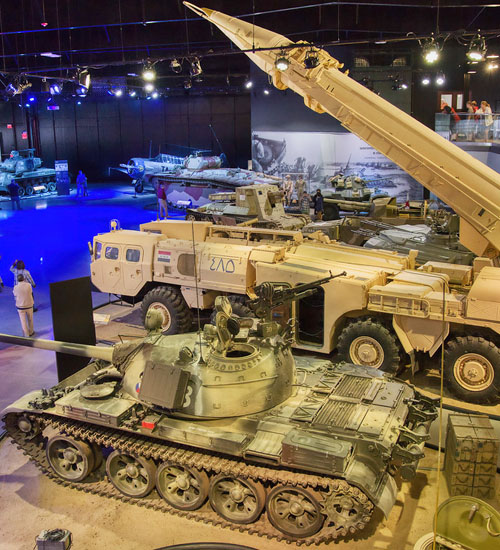
M551 Sheridan – USA | AMPHIBIOUS TANK
M60A1 – USA | TANK
T-55 – IRAQ | TANK
SS-1C Scud-B (R-17/R-300 Elbrus) & MAZ-543 – IRAQ | MISSILE & LAUNCHER
ZSU-23-4 SHILKA – IRAQ | ANTI-AIRCRAFT TANK
2S1 GVOZDIKA – IRAQ | SELF PROPELLED HOWITZER
Persian Gulf War
Though the long-running Iran-Iraq War had ended in a United Nations-brokered ceasefire in August 1988, by mid-1990 the two states had yet to begin negotiating a permanent peace treaty. When their foreign ministers met in Geneva that July, prospects for peace suddenly seemed bright, as it appeared that Iraqi leader Saddam Hussein was prepared to dissolve that conflict and return territory that his forces had long occupied. Two weeks later, however, Hussein delivered a speech in which he accused neighboring nation Kuwait of siphoning crude oil from the Ar-Rumaylah oil fields located along their common border. He insisted that Kuwait and Saudi Arabia cancel out $30 billion of Iraq’s foreign debt, and accused them of conspiring to keep oil prices low in an effort to pander to Western oil-buying nations.
Realizing Iraq’s debt would not be forgiven and his ability to control and sell oil was in jeopardy, Saddam Hussein ordered the invasion and occupation of neighboring Kuwait in early August 1990. Shocked by these actions, fellow Arab powers such as Saudi Arabia and Egypt called on the United States and other Western nations to intervene. Hussein defied United Nations Security Council demands to withdraw from Kuwait by mid-January 1991, and the Persian Gulf War began with a massive U.S.-led air offensive known as Operation Desert Storm. After 42 days of relentless attacks by the allied coalition in the air and on the ground, U.S. President George H.W. Bush declared a cease-fire on February 28; by that time, most Iraqi forces in Kuwait had either surrendered or fled. Though the Persian Gulf War was initially considered an unqualified success for the international coalition, simmering conflict in the troubled region led to a second Gulf War, known as the Iraq War, that began in 2003.
Iraq War
In 2002, the new U.S. president, George W. Bush, argued that the vulnerability of the United States following the September 11 attacks of 2001, combined with Iraq’s alleged continued possession and manufacture of weapons of mass destruction and its support for terrorist groups – which, according to the Bush administration, included al-Qaeda, the perpetrators of the September 11 attacks—made disarming Iraq a renewed priority (both accusations proved erroneous).
When Hussein refused to relinquish his leadership and leave Iraq, U.S. and allied forces launched an attack on the morning of March 19, 2003. The United States, along with coalition forces primarily from the United Kingdom, initiated war on Iraq. Just after explosions began to rock Baghdad, Iraq’s capital, U.S. President George W. Bush announced in a televised address, “At this hour, American and coalition forces are in the early stages of military operations to disarm Iraq, to free its people and to defend the world from grave danger.” President Bush and his advisors built much of their case for war on the idea that Iraq, under dictator Saddam Hussein, possessed or was in the process of building weapons of mass destruction.
No active major weapons of mass destruction were found in Iraq. The U.S. declared an end to the war in Iraq on December 15, 2011, nearly ten years after the fighting began. The American forces suffered over 4,000 combat deaths and over 32,000 wounded during the Iraq War. It is estimated that somewhere between 7,400 to 20,000 civilians had been killed, primarily by U.S. air-and-ground forces.