
So, You Want to be an M18 Hellcat Gunner?![]()
![]() #AmericanHeritageMuseum #visitma #militaryhistory #historymuseum #WWII
#AmericanHeritageMuseum #visitma #militaryhistory #historymuseum #WWII
ONE OF WWII’S MOST DARING AIR RAIDS. ONE UNFORGETTABLE NIGHT AT AHM.![]()
![]() On Thursday, November 5, the American Heritage Museum welcomes New York Times bestselling author Adam Makos for a special History After Hours presentation celebrating his new book, “Tidal Wave”.
On Thursday, November 5, the American Heritage Museum welcomes New York Times bestselling author Adam Makos for a special History After Hours presentation celebrating his new book, “Tidal Wave”.![]()
![]() Released just two days earlier, “Tidal Wave” tells the gripping story of the August 1, 1943 raid on Ploesti, Romania, when American B-24 Liberator crews flew at extremely low altitude through fighters, flak, smoke, and fire to strike critical Axis oil refineries.
Released just two days earlier, “Tidal Wave” tells the gripping story of the August 1, 1943 raid on Ploesti, Romania, when American B-24 Liberator crews flew at extremely low altitude through fighters, flak, smoke, and fire to strike critical Axis oil refineries.![]()
![]() If you know Makos from “A Higher Call”, “Spearhead”, or “Devotion”, you know how powerfully he brings military history to life.
If you know Makos from “A Higher Call”, “Spearhead”, or “Devotion”, you know how powerfully he brings military history to life.![]()
![]() Now hear the story directly from him.
Now hear the story directly from him.![]()
![]() 📅 Thursday, November 5
📅 Thursday, November 5![]() 🎤 Presentation: 7:00–8:00 PM
🎤 Presentation: 7:00–8:00 PM![]() ✍️ Book signing immediately following
✍️ Book signing immediately following![]()
![]() Copies of Tidal Wave will be available through event registration, and Adam Makos will personally sign books after the presentation.
Copies of Tidal Wave will be available through event registration, and Adam Makos will personally sign books after the presentation.![]()
![]() 🎟️ Advance registration is strongly recommended.
🎟️ Advance registration is strongly recommended.![]()
![]() Reserve your tickets and copy of “Tidal Wave” at AmericanHeritageMuseum.org or the link in our bio.
Reserve your tickets and copy of “Tidal Wave” at AmericanHeritageMuseum.org or the link in our bio.![]()
![]() #visitma #AdamMakos #b24liberator #WWII #ploesti
#visitma #AdamMakos #b24liberator #WWII #ploesti
Get a front-row seat to World War II history this weekend at the Battle for the Airfield WWII Re-enactment Weekend at the American Heritage Museum, October 10-11, 2026. Two massive battles daily with real tanks, vehicles, artillery, and even airplanes! Get tickets at the link in our bio or at AmericanHeritageMuseum.org! #WWII #visitma #tanks #metrowestma #WorldWarII
Get ready for the Battle for the Airfield WWII Re-Enactment this Saturday & Sunday, October 10-11, 2026! Get tickets at: ahmus.me/bfta26
Who is excited for the Battle for the Airfield WWII Re-Enactment Weekend next weekend!? For those of you who have experienced it before, how many years have you attended? (Photos by Roland Brooks) - Get your tickets today at: ahmus.me/bfta26
Defense of the Reich
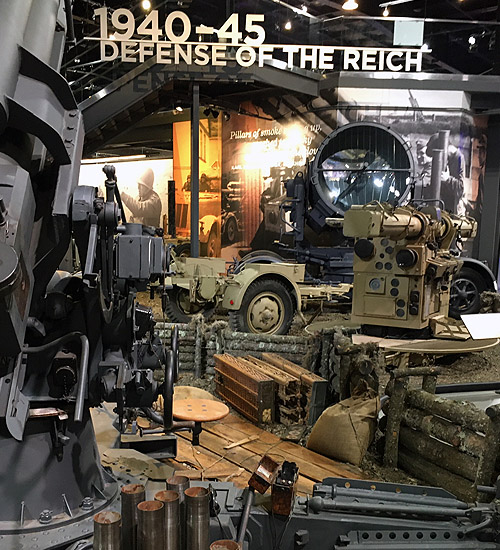
8.8 cm Flak 36 – GER | ANTI-AIRCRAFT GUN
Sd.Kfz. 8 12 TON – GER | PERSONNEL CARRIER/PRIME MOVER
Kommandogerrat 38 – GER | FIRE CONTROL COMPUTER
Flak Battery Generator – GER | ANTI-AIRCRAFT BATTERY SUPPORT
Flak Battery Searchlight – GER | ANTI-AIRCRAFT BATTERY SUPPORT
V-1 (“JB-2 Loon” – Suspended) – GER | GUIDED MISSILE
The Defense of the Reich (also known in German as Reichsverteidigung) was the name given to the strategic defensive aerial campaign fought by the Luftwaffe air arm of the combined Wehrmacht armed forces of Nazi Germany over German-occupied Europe and Nazi Germany during World War II. Its aim was to prevent the destruction of German civilians, military, and civil industries by the Western Allied bombing campaigns. The day and night air battles over Germany during the war involved thousands of aircraft and aerial engagements to counter the Allied strategic bombing campaign. The Luftwaffe fighter force defended the airspace over German-occupied territory against attack, first by RAF Bomber Command and then against the United States Army Air Forces.
The constant night bombing by the RAF and daylight attacks by the USAAF added to the destruction of a major part of the German’s industries and cities, which caused the economy to collapse in the winter of 1944–45. It also pulled nearly two million Germans into defense of the homeland and diverted critical, dual-purpose 88 mm guns from an anti-tank role in the east against the advancing Red Army to an antiaircraft role inside Germany itself. By this time, the Allied armies had reached the German border and the strategic campaign became fused with the tactical battles over the front, while also completing a deliberate and methodical Allied campaign of punishment of all of Germany by destruction of German cities and civilian morale. The air campaign continued until April 1945, when the last strategic bombing missions were flown, ending just before the surrender of Germany on May 8th.